About Nikka
Connecting design intent with production reality.
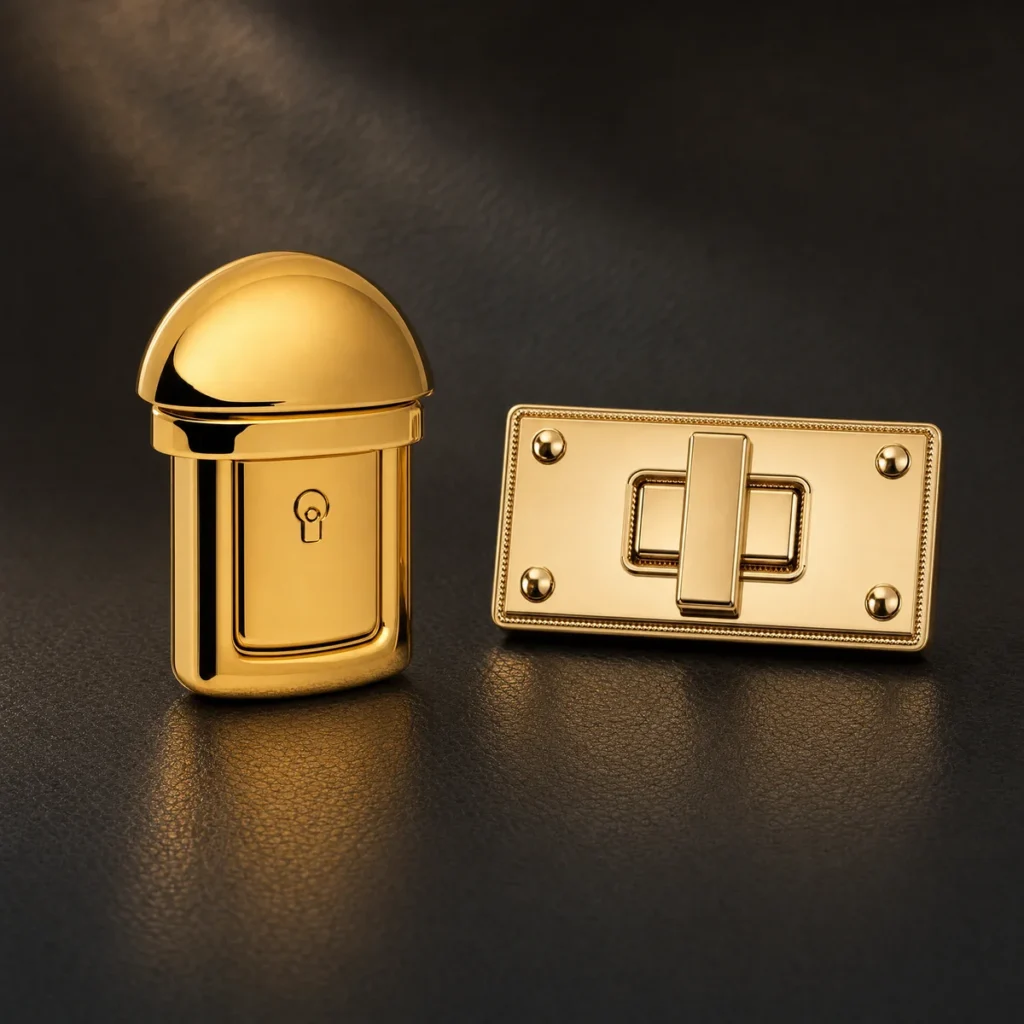
Nikka Industrial Limited develops precision metal hardware for luxury bags, leather goods and accessories — closures, buckles, zippers, rings, adornments and related parts — and oversees manufacturing from development through delivery. We are headquartered in Causeway Bay, Hong Kong, with operations in Guangzhou, China. Acting as the central development and project-management hub, we align material choice, process route and finish requirements for brands where visible hardware has to be right. Production runs through certified partner factories that remain fully open to client audits. Client references and project details are available on request, under NDA where required.
Since 2008
Nearly two decades in fashion hardware development
Hong Kong
Commercial base directing specialized Asian manufacturing partners
ISO 9001 / 14001 / 45001
Certification held by our zinc alloy and stainless steel partner factories
±0.01 mm
Achievable on select critical dimensions with secondary machining; typical MIM tolerance ±0.3%
Our story
A founder-led business built around coordination, precision and follow-through.
Nikka was founded in 2008 by Allen Yi after years spent across finance, export manufacturing and supply-chain coordination. The company was built to address a familiar problem in fashion hardware: visible parts are often judged on design, but projects fail on inconsistent execution, unclear specifications and late correction. From the start, Nikka was structured to bring tighter control to how hardware is developed, specified and delivered.
Founder
From finance into manufacturing coordination.
Before founding Nikka, Allen Yi worked in banking at Citibank and then spent seven years in export manufacturing. That background shaped a business that approaches hardware with both commercial discipline and production realism — balancing surface expectations, technical feasibility and delivery commitments from the beginning of the brief.
“Serve with PRIDE.” — Allen Yi, Founder
PRIDE = Proactive / Responsive / Integrity / Dedication / Entrepreneurial
Milestones
How the company developed.
Chapter 01
— Origin (2008): Nikka began as a founder-led business built on the fundamentals: clear communication, steady quality control and careful project handling.
Chapter 02
— Luxury focus (2016): The business moved further into handbag hardware for the top end of the market, adapting to the higher expectations around finish consistency, visible detail and supplier responsiveness that premium brands bring.
Chapter 03
— Today: Alongside established work in zinc alloy and brass, Nikka has expanded into 316L stainless steel, aluminum alloy and, in recent years, MIM for projects that require tighter geometry, stronger wear performance and a more demanding surface standard.
How we work
How a project with Nikka actually runs.
We do not force every part through a single production route. From Hong Kong, we run specialized production routes — so each project follows the path that fits the part and the commercial brief.
Early alignment
Align early, before expensive decisions harden.
The best time to involve us is while material, finish and mechanism are still open questions — before the wrong choice becomes expensive to reverse.
Specialized routes
One point of contact, multiple specialized routes.
Different projects call for different strengths — zinc alloy, brass, stainless steel, MIM or electroplating. We coordinate the right path for the brief rather than forcing every part through the same production logic.
Delivery discipline
Commercial discipline supports delivery discipline.
Realistic specifications and disciplined production management keep development and production on schedule across multi-material programs.
Materials & proof
Where our capability shows.
From base metals to finishing and delivery, these are the areas where our work is most visible.
Materials
Materials & process routes.
Zinc alloy, brass, 316L stainless steel and aluminum alloy, with MIM for complex geometry and electroplating for decorative surfaces.
Precision
Precision where the part demands it.
For select critical dimensions, our MIM capability holds tolerances down to ±0.01 mm through secondary machining, while typical as-sintered MIM tolerances remain around ±0.3%.
Certification
Certified partner factories.
Our zinc alloy and stainless steel partner factories hold ISO 9001, ISO 14001, and ISO 45001 certification, covering quality, environmental and occupational health and safety management.
FAQ
What buyers ask before they brief us.
Straight answers to the questions we hear most.
What does Nikka make, and who is it for?
Custom metal hardware for bags and accessories — closures, buckles, zippers, rings and decorative parts, developed to each brand’s specification.
Which materials and processes do you work with?
Our core routes are zinc alloy, brass, 316L stainless steel and aluminum alloy; MIM takes on the intricate shapes, and electroplating delivers the final look.
Do you manufacture in-house or coordinate partner factories?
Nikka builds and runs the system that turns a designer’s drawing into finished metal hardware — and answers for every stage of it. Production sits with a deliberately small circle of partner factories, each developed over more than a decade to luxury-export standards — our zinc alloy and stainless steel partners certified to ISO 9001, ISO 14001, and ISO 45001 — and clients are welcome to audit them at any time. That depth, not breadth, is what allows one-stop work across zinc alloy, brass, stainless steel and aluminum alloy. Engineering, quality and delivery carry a single signature: ours.
How should a project start?
Start with a concept, a current part or a reference image via the Contact page — or start from Products if your team still needs to narrow the right hardware family.
Get in touch
Ready to bring a hardware partner into your next collection?
Send us whatever you have — we will map it to the right production route and come back with the questions that matter. If the brief is still taking shape, the Products page is a good place to explore.